
纸牌屋第二季
巳蛇嬉嬉,童游非遗中国年!第十八站:泉城新春烟火气_我的网站

A |

There was no narration explaining the mythology behind palaces rising above an ocean of clouds in the video, nor subtitles identifying the heavenly gates, cranes or tiny figures moving beneath them.
Yet viewers outside China quickly began naming the world for themselves.
Some called it "paradise." Others saw a "Celestial Palace" or an "Immortal Realm" familiar from Chinese fantasy games and television dramas. One user wrote, "Waiting on Wukong to show up," invoking the Monkey King from the Chinese literary classic "Journey to the West," or the hit game "Black Myth: Wukong."
The interpretations differed, but viewers did not seem to need the same cultural knowledge to enter the conversation.
Earlier this month, Chinese foreign ministry spokesperson Mao Ning shared the 33-second AI-generated video on social media with a question: "What does the Chinese heaven look like?"
It opened up a hermeneutic discussion, with responses overseas suggesting a cultural image does not necessarily need to elicit exactly the same interpretation for everyone in order for it to be viewed meaningfully.
"The right to interpret ultimately lies with the audience," said Zhang Zheng, deputy dean of Tsinghua University's School of Journalism and Communication.
People encountering unfamiliar cultures inevitably draw on what they already know, Zhang said. Rather than fully grasping every cultural reference, what matters is whether audiences can encounter the work, understand it and respond to it emotionally.
Before strangers abroad could interpret this particular world, however, it first had to get out of one man's head.
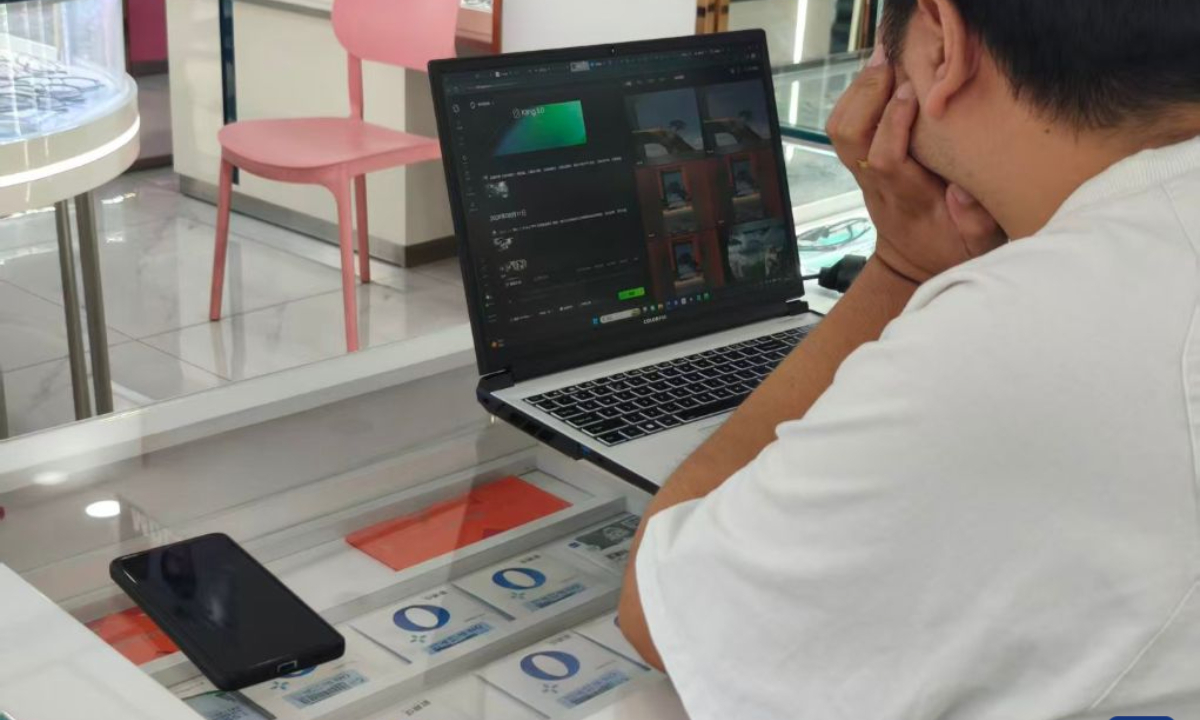
Chen Aijun, 34, is an optometrist in Chengdu, capital of southwest China's Sichuan Province.
By day, Chen leads a quiet, down-to-earth life in a neighborhood optical shop. Inside, he worked among eyeglass frames and optometry equipment. On his computer was another landscape entirely: cloud seas, immense palaces, flying cranes and figures in ancient robes.
Chen's heaven did not come from any single ancient text.
Growing up in the 1990s, he watched "Journey to the West" and later encountered "The Investiture of the Gods," xianxia (immortal heroes) novels and fantasy games. Those stories mixed over time with images of Chinese architecture and landscapes he saw online.
He has never visited nearby Mount Emei, and most of what he knows of Mount Huangshan's famous sea of clouds comes from videos.
What appeared on his screen was therefore not a reconstruction of one fixed mythological scene, but a world shaped by traditional stories already filtered through television, novels, games, the internet and his own memory.
For years, Chen had no way to make that world visible.
He never studied painting, design, photography or 3D modeling. After high school, he joined his parents' optical business and eventually took over the shop.
Generative AI changed the gap between imagining an image and possessing the technical skills to show it to someone else.
More than a year ago, Chen began teaching himself through free online tutorials. In September 2025, he started regularly posting AI videos, and a month later began experimenting with palaces floating above clouds. He has since published more than 200 videos.
The process, however, involves far more than entering a few prompts. The technology lowered the technical threshold, but it did not make the choices for him.
When creating Nantianmen, the mythical heavenly gate, Chen first defines the spatial rhythm and tonal hierarchy, pairing towering architecture and cloud seas with deliberately miniature figures to amplify the celestial realm's grand scale.
If the result does not match the picture in his mind, he tries again. He often generates over 1,000 images a day, revising a single scene repeatedly before moving on to animation, editing, color grading and music.
The machine can generate a thousand possible heavens. Chen still has to decide which one is his.
"AI-produced images can be soulless, and it takes human inspiration and aesthetic sensibility to endow works with warmth and vitality," he said.
Zhang believes Chen's experience reflects a broader shift brought about by generative AI. He said AI is giving people without conventional artistic training access to forms of expression that once required specialized skills. But what they create still depends on what they bring to the tool.
"A person's existing knowledge inevitably shapes how they use AI," Zhang said.
Chen brought his memories to the machine. Viewers abroad, in turn, brought theirs to the image.
"Everyone brings their own associations to these scenes," he said.
If his imagined world had to be reduced to three elements, he would keep clouds, architecture and people. The first two should feel immense, he said, while the last should remain small.
The details are culturally specific, but the visual effect is more immediate: tiny human figures dwarfed by vast clouds and monumental architecture. The responses suggest that viewers did not need to understand every cultural reference to find a way into the image.
Chen has no overseas social media accounts and learned that the video was attracting attention abroad only when friends sent him screenshots.
His life at the optical shop has changed little. He still checks eyesight and fits glasses when customers come in, then returns to his computer when the shop grows quiet.
He now hopes to make longer AI videos with fuller stories. He also wants to visit Mount Emei and, one day, Mount Huangshan.
For years, images of distant mountains and clouds reached Chen through screens. His imagined landscapes later traveled through screens to people he had never met.
Now he wants to see the real mountains and clouds for himself.
。

B | 巳蛇嬉嬉, 童游非遗中国年! 第十八站:泉城新春烟火气 趵突泉边的红灯笼刚挂上树梢,芙蓉街的青石板已漫起糖瓜的甜香。当曲水亭街的老茶碗续上第七道泉水,济南这座城市便瞬间被浓郁的年味所笼罩着,让我们一起来到童游非遗中国年的第十八站-济南,感受春节济南的魅力! 剪一片月光,把祝福贴在窗上 小剪刀,咔嚓嚓,剪只福虎墙上挂!"济南剪纸艺术是国家级非遗,老艺人能用一张红纸剪出泉城柳、荷花鲤,连趵突泉的三股水都跃然纸上。

C | 济南剪纸 春 节 面团里的魔法剧场 济南过年有个超厉害的习俗——面塑,它可是国家级非遗!过年时,济南的大街小巷都能看到面塑摊。师傅用彩色面团,三两下就能捏出可爱造型。

D | 面塑不仅好看,还带着吉祥寓意。

E | 鼓点里的千年心跳 "咚咚锵!"当章丘芯子的娃娃们扮成哪吒踩着高架巡游,当商河鼓子秧歌的伞、鼓、棒划出欢快的弧线,这就是济南人血脉里的春节BGM!这些国家级非遗项目,用最热闹的方式讲述着黄河岸边的故事。快带宝贝去看社火表演,让他们跟着鼓点扭起来吧! 章丘芯子 鼓子秧歌 舌尖上的非遗地图 在芙蓉街的老巷里,糖画艺人手腕轻转就画出会飞的糖凤凰;把子肉在百年老汤里咕嘟作响;杨氏茶汤的龙嘴大铜壶扬起一道琥珀色的弧线…带孩子用舌尖丈量济南非遗美食地图,让老味道成为童年最甜的春节记忆。 糖画 把子肉 – SPRING FESTIVAL – 茶 汤 SPRING FESTIVAL 这个春节,我们和孩子们踏上了一段奇妙的"寻找年味之旅"!从北方窗花剪纸的魔法剪刀,到南方醒狮的威风步伐;从热气腾腾的团圆饺子,到甜甜蜜蜜的八宝年糕……每一场非遗邂逅都是时光馈赠的成长礼物,让孩子们用指尖触摸文化温度,用舌尖跳跃家乡滋味。 让我们共同呵护这些在童年生根的文化嫩芽,期待每个孩子都能成为最棒的"小小传承人",让带着祖辈温度的年俗故事,继续在他们未来的人生里绽放光彩! 中二班的小朋友来给大家拜年了 撰稿 | 唐妙红 编辑 | 陈健彬 审稿 | 唐妙红 审核 | 于美华。
Current article:http://2xsuz.diapoqiechuangpenghua.sbs/qo2l/gups4pk.html
Published on:00:53:13
我的网站相关阅读
- 我军055万吨大驱发射导弹5发5中! 舰员:炮弹按钮随时给敌人准备着
- 德福科技:子公司表面处理机可补充公司HVLP系列铜箔扩产需求
- When a Chinese mythic world travels without translation
- “油蜡联产”项目全面告捷 抚顺石化提质增效添引擎
- 美国中央情报局局长秘密访俄,出访前告知乌克兰,并要求乌暂停空袭;俄称此次访问涉及“情报部门之间的接触”
- 新西兰废除2条重要政策!总理被催讨退钱……
- 杭州口岸2026暑运客流结构有较大变化 入境外籍旅客超27万人次同比增超12% 免签入境外籍旅客超16万人次同比增超20%
- 100%夺冠定律!詹姆斯复刻4次夺冠配方,76人夺冠底色早已成型
- 吃安眠药喝咳药水 男子求助戒20年瘾
我的网站最新文章
- Bollywood and The Middle East: A Growing Connection
- 斯科特:科比教会我本可以做得更多 我本可以4点起床训练
- 华硕罗格追光旗舰长椅:6核i9/rtx 2080,售价39999元
- Iraqi parliament elects Abdul Latif Rashid as country's president
- 王鑫明天将发布一个匿名的社交应用“马桶山”,该应用已经被微信屏蔽和分享。
- 天文学专业走热带来的启示
- Congress presidential polls underway
- Chinese FM appreciates Malaysian PM Anwar's Taiwan remarks, reiterates China must and will be reunified
- 助力推进乡村振兴,未来五年山东审计将从四个方向精准发力
- 极氪发布最新概念车0.01:6岁孩童操刀设计
- 创历史新高!我国44名专家获“IEC 1906奖”
- “福泽江淮·彩惠民生”——铜陵福彩销售员走进枞阳县福利院
- 9月13日12时—16时,河北石家庄裕华区新增5例阳性感染者,轨迹公布
我的网站随机推荐
- 莫雷托:米兰仍未与波尔图就希门尼斯转会达成协议,将进一步接触
- 전북도, 무주 항공·우주산업 투자선도지구 전담행정지원 가동
- 泄露的2亿份中文简历的来源证实了原项目已被删除。
- 吹糖人:舌尖上的传承
- 西港警方驱逐两中国人
- रांची के सिविल सर्जन ने हाई कोर्ट में स्वीकारी चूक,खून चढ़ाने के बाद बच्चे के एचआइवी संक्रमित होने का मामला
- 2026乒超雄安站男团积分排名落定,积分循环赛正式开战
- [지금 중동은] “아이들아, 연 날리지 마…폭격 맞을 수 있어”
- 年轻人花50块买一张贴纸,图啥?
- 14 शहरों में दिखाई जाएगी बनारस के फिल्मकार ज़ैग़म इमाम की फिल्म, जागरण फिल्म फेस्टिवल में "द नर्मदा स्टोरी" का वर्ल्ड प्रीमियर
- 美球、飞机猫“生面孔”榴梿 摊贩:名字特别或吸引老饕尝试
- Scholz Sparks Media ‘Sh*tstorm’ by Evading Reporter’s Question on Ukraine While Smiling
- 开封购彩者中得顶呱刮“十倍幸运”一等奖